
You’ve probably heard many different sorts of comparisons between Python Vs. Java, such as “Java is quicker than Python” or “Python is more secure than Java.”
This essay will discuss the similarities and differences between these two languages, as discussed by Nakul Chetiwal, and help you decide which is best.
Table of Content:
To begin, both languages are general-purpose object-oriented and extensively utilized in constructing a broad range of internet-hosted applications, but if we’re talking about who was around first, it was Java; Python just became a reality and became widely accessible around the year 2000.
We are not claiming that Python Vs. Java is superior since it would be a blanket statement that ignores multiple variables.
The two languages are distinct in the frameworks they use. To provide just two examples, both the Spring and Django frameworks for Java and Python, respectively, are very robust and are used by millions of developers across the globe.
It’s impossible to determine which is superior since each developer has preferences for what they feel most at ease writing code.
While it’s true that different people have varying degrees of success with Java and Python, we all benefit from the frequent practice. If you take the time to learn Python, you’ll eventually agree that it’s the top choice among programming languages.
Let’s compare and contrast the two languages in some key areas now.
My code written in Java runs faster than Python. Should I Learn Java?
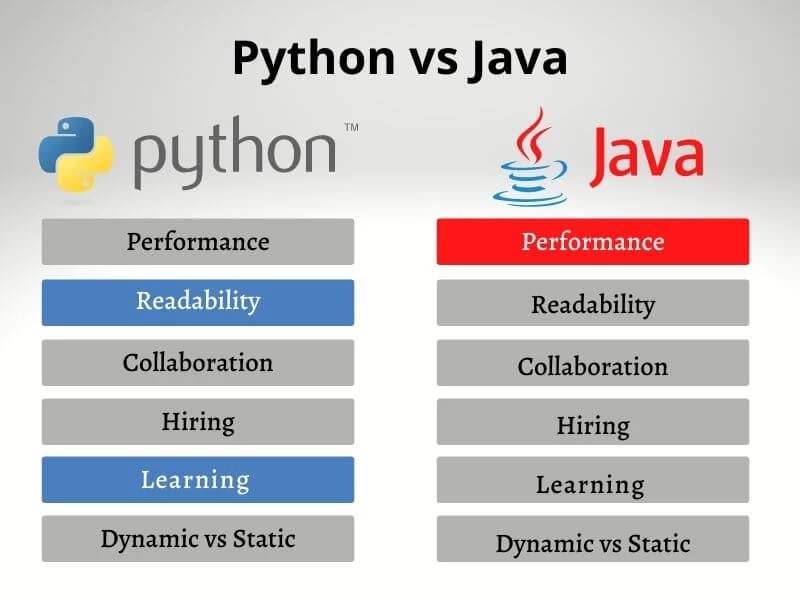
If we’re talking about how fast things get done, then yes! Java’s compilation and execution times are lower than Python’s, but how come? Does Python need compilation?
The code in Python is compiled and transformed to bytecode before it is executed, which most people are unaware of. How does it function, then? To get to the bottom of this, let’s talk.
We all know that the JVM (Java Virtual Machine) takes the source code, converts it into bytecode, and then executes it to produce the result. While it is true that Python is an interpreted language, this does not imply that it does not undergo the compilation process.
Python is dynamically typed, allowing you to simply write the variable name and initialize it without specifying its data type, in contrast to Java, which is statically typed and requires you to describe the variable’s data type when you create it. The interpreter checks all Python variables, while Java’s type checking and other validations happen at compilation time.
Python code is written in.py files, and when run with the python name.py, the resulting bytecode is kept in a local directory. To simplify the process for the user, this information is withheld from them. Compilation and interpretation take place, but who goes through it first?
Python’s compilation happens automatically during execution. There’s no need to execute the bytecode.
Whether Python is compiled or interpreted is a point of debate among developers. This is because… Python may be run in either an interpreted or compiled mode. Remember this the next time someone asks you a dumb question.
Python’s bytecode is automatically built and interpreted, but Java’s must be manually executed by the JVM.
You may believe that Python is more efficient, but it isn’t. The Java Virtual Machine (JVM) is responsible for Java’s speed; it executes bytecode much more quickly than the Python Virtual Machine (PVM), which simplifies and accelerates the development process.
Which one is Good for Game Development?
If we’re talking about the frameworks used to make games, both are available. Python outnumbers Java when it comes to frameworks in this area. Since Python is a programming language, it’s used by the vast majority of the gaming industry, making it an ideal choice for developing games.
Even though it’s not as common as Python, Java may also be used to create games. Python has various libraries and robust engines, making it ideal for developing cutting-edge visual effects.
A game cannot be built only in Python Vs. Java. Other languages will be needed for this purpose. You should reconsider your goals if you want to learn Python and use it to create a game in a week.
Which one is better for web applications?
In today’s age of web-based apps, data protection, and processing speed are paramount. Django and Spring are both useful frameworks; hence, either language might do the job.
A huge framework, Spring is broken up into smaller modules specializing in certain areas like cloud computing, security, etc. This method is quick and safe as well. Web applications built using Django benefit from its security and scalability.
Conclusion
We hope you’ve learned from this post that both are superior in their own right. Languages are only a means to educate your computer, and as such, they are not regarded as skills on par with reasoning. It’s only a method of execution.
 Nakul Chetiwal